


 Free Newsletter

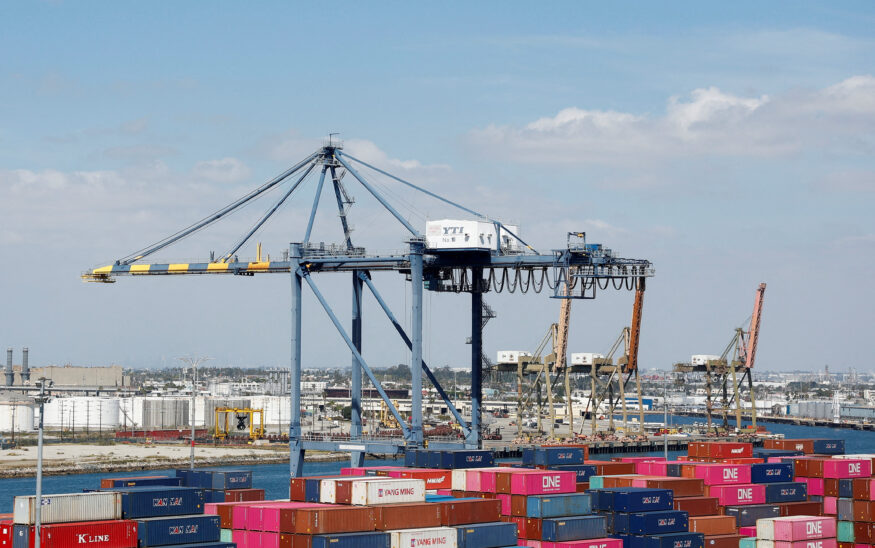
FILE PHOTO: Shipping containers are stacked at a terminal at the port of Los Angeles in Long Beach, California, U.S., March 10, 2026. REUTERS/Caroline Brehman/File Photo
US trade court weighs legality of Trump 10 percent global tariff
Reuters//April 10, 2026//


Summary:
- Three-judge panel hears case at U.S. Court of International Trade
- Tariffs challenged by 24 states and two small businesses
- Tariffs imposed under Section 122 of the Trade Act of 1974
By Dietrich Knauth
NEW YORK, April 10 (Reuters) – A U.S. trade court on Friday considered the legality of a 10 percent global import tax imposed by the Trump administration, which several states and small businesses say sidesteps a U.S. Supreme Court ruling that invalidated most of Trump’s previous tariffs.
A group of 24 mostly Democratic-led states and two small businesses sued the Trump administration to stop the new tariffs, which went into effect on February 24.
The hearing is before a three-judge panel of the U.S. Court of International Trade.
Oregon’s lawyer Brian Marshall told the judges that the latest tariffs are based on archaic authority that was meant to protect the U.S. dollar from sudden depreciation in the 1970s, when dollars could be exchanged for gold reserves held in Fort Knox.
Marshall said that authority was meant to resolve significant “balance of payments deficits,” and Trump cannot repurpose it to address routine trade deficits.
“They have a different meaning of what ‘balance of payments deficits’ means,” Marshall said at the court hearing.
Trump has made tariffs a central pillar of his foreign policy in his second term, claiming sweeping authority to issue tariffs without input from Congress.
The administration has said that global tariffs are a legal and appropriate response to a persistent trade deficit caused by the fact that the U.S. imports more goods than it exports.
Trump imposed the new tariffs under Section 122 of the Trade Act of 1974, which authorizes duties of up to 15 percent for up to 150 days on imports during “large and serious United States balance-of-payments deficits” or to prevent imminent depreciation of the dollar.
The states and small businesses argue that the Trade Act’s tariff authority is meant only to address short-term monetary emergencies, and routine trade deficits do not match the economic definition of “balance-of-payments deficits.”
Trump announced the new tariffs on February 20, the same day the Supreme Court handed him a stinging defeat when it struck down a broad swath of tariffs he had imposed under the International Emergency Economic Powers Act (IEEPA), ruling that the law did not give him the power he claimed.
No U.S. president before Trump had used the IEEPA or Section 122 to impose tariffs. The two lawsuits do not challenge other Trump tariffs made under more traditional legal authority, such as recent tariffs on steel, aluminum and copper imports.
(Reporting by Dietrich Knauth; Editing by Noeleen Walder, Lisa Shumaker and Franklin Paul)
Related Articles
Related Content






Legal Tech
- How ransomware tactics against law firms are changing
- How large language models are leveling the personal injury playing field
- Attorney Share, Lawmatics integrate to automate law firm referrals
Top Legal News
- Biz Court: Firing an owner doesn’t end membership or voting rights
- Michigan couple sues Taylor Farms, Taco Bell after getting cyclosporiasis
- US judge casts doubt on 69,000 cases alleging J&J talc caused cancer
- Rockingham County asks NC Supreme Court to toss casino-related rezoning lawsuit
- Dutch judgment may provide alternate route to enforce arbitration award
- Legally Speaking: How communication failures turn disputes into lawsuits
- AG Jackson refuses to sign Duke Energy rate settlement




Commentary
- Legally Speaking: How communication failures turn disputes into lawsuits
- We tore out our own backup generator
- When is a PIP an adverse employment action?
- Legally Speaking: What spring can teach us about active listening
- A useful patent management government notice
- Opinion: NC judges have enormous power. Be sure to vote in November
- The third option: Why your best employees are quietly losing their edge
- AI divorce is real, but family law can still save itself
