


 Free Newsletter

Attorney: Phrase in SCOTUS opinion suggests end for ‘Texas two-step’
BridgeTower Media Newswires//June 13, 2024//

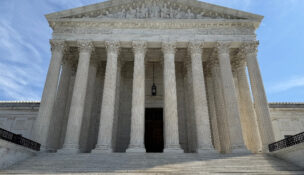
The Texas two-step bankruptcy defense might be threatened by a small-but-important phrase is a recent U.S. Supreme Court opinion. (Depositphotos.com)
Attorney: Phrase in SCOTUS opinion suggests end for ‘Texas two-step’
BridgeTower Media Newswires//June 13, 2024//


By Kris Olson
It may have been only three words in a U.S. Supreme Court decision. But plaintiffs’ attorney Michael C. Shepard of Boston hopes they portend that the last dance is near for the notorious bankruptcy strategy known as the “Texas two-step.”
The case, Truck Insurance Exchange v. Kaiser Gypsum Co. Inc., et al., does not directly involve the Texas two-step. Instead, a unanimous Supreme Court (8-0, with Justice Samuel Alito recused) held that an insurer with financial responsibility for bankruptcy claims is a “party in interest,” as that term is defined in 11 U.S.C. §1109(b). That status gave it the power to raise and be heard on any issue in a Chapter 11 case, the court found.
But before getting into the nitty gritty of the core issue, Justice Sonia Sotomayor laid the groundwork.
“Bankruptcy offers individuals and businesses in financial distress a fresh start to reorganize, discharge their debts, and maximize the property available to creditors,” she wrote in the court’s June 6 opinion.
It is the phrase “in financial distress” that gives Shepard, a member of the asbestos claimants’ committees of four bankruptcies pending in the Western District of North Carolina, hope.
The companies that have deployed the Texas two-step to spin off significant mass tort liabilities for asbestos and other claims into new companies that then declare bankruptcy are hardly in dire financial condition.
“That is the Supreme Court looking at what’s coming down the road,” Shepard says. “What the Supreme Court is indicating in [the Truck Insurance] case is that the Bankruptcy Code is going to be strictly interpreted.”
Not only might that not bode well for the adherents of the Texas two-step, but it may also spell trouble for members of the notorious Sackler family. They have a release from civil liability for opioid-related claims hanging in the balance of another bankruptcy matter pending before the Supreme Court, Harrington v. Purdue Pharma L.P.
That release would be part of a multibillion-dollar bankruptcy plan for Purdue Pharma, with the justices now weighing whether claims held by nondebtors against nondebtor third parties can be extinguished without the claimants’ consent. A decision is expected before the court begins its summer recess at the end of this month.
While not obviously related, the Harrington case may also sprinkle a few two-step-related tea leaves, according to Shepard.
Ideally for Shepard and the other members of the claimants’ committees, the Supreme Court would rule against the Sacklers, saying essentially that obtaining the benefit of a bankruptcy injunction requires an individual or entity being part of the bankruptcy proceedings and subject to the court’s oversight.
“If you can’t protect the ‘good’ company — the company with all the assets that’s not in bankruptcy — then there’s no purpose in doing the Texas two-step,” Shepard says.
However, if the Supreme Court allows the Sacklers to get relief from future liability by virtue of their contribution to the bankruptcy plan, that would still not be the equivalent of the Supreme Court giving the Texas two-step its blessing, Shepard adds.
“All it means is this issue of a preliminary injunction or a permanent injunction against claims being extended to a non-debtor entity is something that’s permissible, and therefore one aspect of the Texas two-step would be allowed,” he says.
The issue of whether a company not “in financial distress” belongs in bankruptcy at all would remain.
The 3rd U.S. Circuit Court of Appeals made its position on the issue known when it ruled last year that Chapter 11 was not available to Johnson & Johnson affiliate LTL Management LLC.
“Good intentions — such as to protect the J&J brand or comprehensively resolve litigation — do not suffice alone,” Judge Thomas L. Ambro wrote for the 3rd Circuit. “What counts to access the Bankruptcy Code’s safe harbor is to meet its intended purposes. Only a putative debtor in financial distress can do so. LTL was not. Thus we dismiss its petition.”
The 4th Circuit now has before it a petition related to the bankruptcy of Bestwall, a spinoff of Georgia-Pacific, which raises the same question.
Shepard says he was initially shocked that the 4th Circuit had accepted a direct appeal in the case of Bestwall, given that it declined a similar invitation in the bankruptcy involving Aldrich, the company that was spun off from Ingersoll Rand.
But what Shepard came to realize is that the petition in Aldrich also swept in a challenge of circuit precedent from 1989 in the case Carolin Corp. v. Miller.
In Carolin, the 4th Circuit established the rule that dismissing a case for lack of good faith requires a showing of both “objective futility” and subjective bad faith. Movants like the creditors’ committees have a hard time meeting that first prong.
By contrast, the Bestwall petition would allow the 4th Circuit to leave Carolin intact and look exclusively at the constitutional basis for a fully solvent company to be in Bankruptcy Court, Shepard says.
“What it allows them to do is leave Carolin alone and not have to address the bad-faith standard, which would impact every bankruptcy in the 4th Circuit,” he says.
“It’s using a laser beam instead of a spotlight,” he adds.
If the 4th Circuit agrees with the 3rd Circuit that financial distress is a prerequisite for entry into the Bankruptcy Court, the Supreme Court would likely deny Bestwall’s inevitable certiorari petition, Shepard figures. If not, the court may need to get involved to resolve the circuit split.
Shepard says there may have been a misperception initially that the four cases in the Western District of North Carolina were your typical Chapter 11 bankruptcies, likely to resolve with a negotiated agreement and an approved plan.
But according to Shepard, the claimants’ committees stressed that they would never agree to a plan that allows fully solvent companies to treat tort victims — asbestos victims or any other kind of victims — “as a line item on their books that they can just offload in bankruptcy.”
Once the judges began to see that the cases were not going anywhere, they began crafting decisions on the claimants’ committees’ motions to dismiss to tee up the relevant issues to the appellate courts.
“One of the takeaways was to pursue your appellate avenues in every case and every context that you can,” Shepard says.
Related Content





Top Legal News
- Deleted files cost defendants in trade secret case, NC Supreme Court rules
- Telecoms denied right to jury in FCC data security actions
- Anthropic urges AI labs to pause development, warns humans risk losing control
- Guilty plea barred direct appeal of habitual felon challenge
- Fabrication claims revived in wrongful conviction lawsuit
- AG Jackson joins coalition urging Congress to reject federal children’s online safety bill
- US Supreme Court sides with FCC in clash with wireless carriers over fines
- Oral compensation agreement claim survives against drone company
- US cites forced labor concerns as grounds for new tariffs
- Future mortgage-interest damages recoverable after delayed home closing
- Excessive force allegations against officers survive dismissal



Commentary
- AI divorce is real, but family law can still save itself
- ‘AI won’t take your job’ and other things CEOs say before the layoffs
- When not to believe (your lyin’ eyes)
- Conduct a technology audit to improve law firm efficiency
- When the client brings ChatGPT to the consultation
- Content Marketing: Where law firms lose referrals and how to prevent it
- Your best people are not leaving for more money — they are leaving because you stopped paying attention
- Best at Work Insights: The choice we’re making about AI
- New life for the noncompete
- 2026: The year of tech, both heroes and villains
- Beyond burnout: The case for workplaces where people thrive
- The December question every leader should anticipate
