


 Free Newsletter

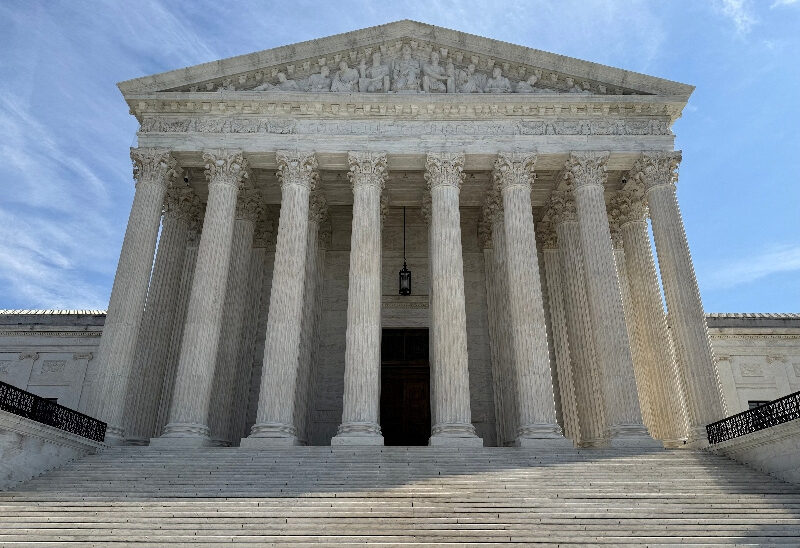
SCOTUS News: ‘State-court loser’ can’t seek relief in federal court
Pat Murphy//June 23, 2026//


Summary:
- Supreme Court affirms Rooker-Feldman Doctrine application
- 4th Circuit upheld dismissal of federal suit for lack of jurisdiction
- Justice Sotomayor authored majority opinion in 5-4 ruling
The Rooker-Feldman doctrine applied to deprive a federal court of jurisdiction to hear a challenge to a state-court consent order imposing conditions on the release of a patient from a psychiatric hospital, the U.S. Supreme Court has ruled in a 5-4 decision.
The Supreme Court in its 2005 decision in Exxon Mobil Corp. v. Saudi Basic Industries Corp. held that, under the Rooker-Feldman doctrine, federal courts lack jurisdiction over “cases brought by state-court losers complaining of injuries caused by state-court judgments rendered before the district court proceedings commenced and inviting district court review and rejection of those judgments.”
The petitioner in the case before the court, T.M., claimed that she has a medical condition that causes changes in her mental status when she ingests gluten. In March 2023, T.M. was taken to the emergency room at Baltimore Washington Medical Center when she experienced a psychotic event after accidentally ingesting gluten.
After an administrative hearing, T.M. was involuntarily committed for approximately three months. During her commitment, T.M.’s treating psychiatrist and the medical center obtained an order authorizing T.M to be forcibly injected with antipsychotic medication.
Meanwhile, T.M. and her parents filed various state and federal lawsuits challenging her involuntary commitment and forced injections.
In June 2023, a state judge in Maryland hearing T.M.’s state habeas petition entered a consent order after the parties had negotiated a settlement. The consent order granted T.M.’s request for an immediate release subject to certain conditions.
Under the order, T.M. was to obtain a new treating psychiatrist, continue taking her medications and dismiss her claims against the respondents.
Meanwhile, T.M. retained new counsel. Ten days after the state court entered the consent order, T.M. sued the respondents in U.S. District Court for the District of Maryland. In the new federal action, the petitioner sought: (1) a declaration that the consent order violated her federal and state due-process rights; (2) a declaration that the order was obtained under duress; and (3) an injunction preventing enforcement of the order.
At the same time, T.M. appealed the consent order in the Appellate Court of Maryland, essentially reiterating the grounds for relief she asserted in federal court.
The state appeals court would subsequently grant T.M.’s motion to stay her appeal to avoid any rulings that would be inconsistent with rulings in her federal case.
However, a federal judge would dismiss T.M.’s lawsuit sua sponte for lack of subject matter jurisdiction under the Rooker-Feldman doctrine. The 4th U.S. Circuit Court of Appeals affirmed, finding no merit to the petitioner’s argument that the Rooker-Feldman doctrine applies only to judgments that are final judgments from the highest court of the state.
T.M. filed a petition for a writ of certiorari for review of the 4th Circuit’s conclusion that the Rooker-Feldman doctrine can be triggered by a state-court judgment that remains subject to further review in state court. The 6th Circuit has reached the same conclusion as the 4th Circuit. On the other hand, the 1st, 2nd, 3rd, 9th, 10th and 11th Circuits have held Rooker-Feldman applies only if the state-court proceedings have “ended.”
The Supreme Court granted certiorari to resolve the circuit split.
In affirming the courts below, the court held that the Rooker-Feldman doctrine deprives federal district courts of jurisdiction over cases brought by state-court losers claiming injuries caused by state-court judgments rendered before the district court proceedings commenced and seeking district court review and rejection of those judgments — regardless of whether the state-court judgment remains subject to further review in state appellate proceedings.
Click here to read the full text of the Supreme Court’s June 18 decision in T.M. v. University of Maryland Medical System Corporation.
To the point
“‘Federal courts are courts of limited jurisdiction and generally can resolve only the cases that Congress grants them power to hear.’ As relevant here, Congress in 28 U.S.C. §1331 granted federal district courts ‘original jurisdiction of all civil actions’ raising federal questions. District courts generally lack ‘any power to review directly cases from state courts.’ Instead, this Court is the only federal court with appellate jurisdiction to review state-court judgments, and that jurisdiction extends only to ‘[f]inal judgments or decrees rendered by the highest court of a State in which a decision could be had.’ §1257(a). Thus, ‘from the beginning we have had in this country two essentially separate legal systems’ with ‘[e]ach system proceed[ing] independently of the other with ultimate review in this Court of the federal questions raised in either system.’…
“T.M. is complaining of injuries caused by, and is seeking relief from, the state-court judgment itself, arguing that the consent order violates her federal and state due process rights and was entered into under duress. The consent order was rendered 10 days before T.M. commenced this federal lawsuit. T.M. plainly seeks ‘review and rejection’ of the consent order by asking the District Court to ‘[d]eclare that the Consent Order’ is ‘unconstitutional, unenforceable, and void ab initio’ and to enjoin ‘enforcement of the Consent Order.’ Thus, T.M.’s case is the ‘paradigm situation in which Rooker-Feldman precludes a federal district court from proceeding’: She does not like the result reached in state court and ‘repaired to federal court to undo the [state] judgment in [her] favor.’”
— Justice Sonia Sotomayor, joined by Justices Clarence Thomas, Samuel A. Alito Jr., Brett M. Kavanaugh and Ketanji Brown Jackson opinion of the court
“When you lose in trial court, you go to an appeals court. The so-called Rooker-Feldman doctrine reflects that commonsense understanding. At its core, the doctrine says that parties who lose in state trial court do not get to appeal to a federal trial court. Instead, they may take their appeal to a state appeals court and, if a federal statute allows, ultimately seek review in this Court. That ‘basic fact’ has been a part of our law for more than 200 years. The Court’s opinion thus properly rejects petitioner’s quest to reimagine, artificially cabin, or overrule Rooker-Feldman. I write separately to explain why Rooker, properly understood, is correct as an original matter.”
— Justice Clarence Thomas, concurring
“Twenty years ago, this Court held that the Rooker-Feldman doctrine is ‘confined’ to the procedural circumstances of the two cases from which the doctrine draws its name. Exxon Mobil Corp. v. Saudi Basic Industries Corp., 544 U.S. 280, 284, 291 (2005); see Rooker v. Fidelity Trust Co., 263 U.S. 413 (1923); District of Columbia Court of Appeals v. Feldman, 460 U.S. 462 (1983). In ‘both cases,’ we emphasized, the federal action was brought ‘after the state proceedings ended.’ Seven Courts of Appeals took us at our word, refusing to apply Rooker-Feldman when the underlying state action remained pending. They were right to hold the line. Because the Court has chosen to relax it, I respectfully dissent….
“The upshot of today’s decision is that the Court has muddied waters that were hardly clear to begin with. That is unfortunate, because there was a better path available: treating Rooker-Feldman as ‘the §1257 Rule.’ Doing so would have been both clearer and more faithful to Exxon.”
“Still, the news is not all bad. Although the Court expands Rooker-Feldman beyond Exxon’s line, it repeatedly emphasizes that the doctrine is ‘narrow.’ Courts should not lose sight of that message. In the end, Rooker-Feldman has been given an inch — it should not be allowed to take a mile.”
— Justice Amey Coney Barrett, joined by Chief Justice John G. Roberts Jr. and, Justices Elena Kagan and Neil M. Gorsuch, dissenting
Related Articles
Related Content


Top Legal News
- US Supreme Court boosts Exxon’s bid to get compensation from Cuba
- SCOTUS News: ‘State-court loser’ can’t seek relief in federal court
- Court of Appeals affirms dismissal of untimely appeal in estate property sale dispute
- US appeals court blocks Trump admin from enacting new plans to slash consumer watchdog staff
- Recovery facility properly classified as assisted living residence
- SCOTUS News: Justices uphold gun rights of marijuana users
- When is a PIP an adverse employment action?
- Lawsuit claims fatal negligence at Brunswick senior home
- Driveway dispute against homeowners association revived
- Judge formally ends US prosecution of Turkey’s Halkbank after Trump deal
- Luigi Mangione due in court June 17 in CEO murder case



Commentary
- When is a PIP an adverse employment action?
- Legally Speaking: What spring can teach us about active listening
- A useful patent management government notice
- Opinion: NC judges have enormous power. Be sure to vote in November
- The third option: Why your best employees are quietly losing their edge
- AI divorce is real, but family law can still save itself
- ‘AI won’t take your job’ and other things CEOs say before the layoffs
- When not to believe (your lyin’ eyes)
- Conduct a technology audit to improve law firm efficiency
- When the client brings ChatGPT to the consultation
- Content Marketing: Where law firms lose referrals and how to prevent it
- Your best people are not leaving for more money — they are leaving because you stopped paying attention
