


 Free Newsletter

The legal confusion surrounding e-bikes
Kallie Cox//July 21, 2026//

The legal confusion surrounding e-bikes
Kallie Cox//July 21, 2026//


Summary:
- Ann Groninger reports increased bike crash cases in Charlotte
- Wilson Jackson cites nearly 60,000 e-bike injuries as of 2024
- BikeWalk NC highlights federal classification loopholes for e-bikes
What counts as an e-bike and what crosses the line into e-moto, moped or small motorcycle territory? It’s a question the federal government and most state and local legislatures have yet to answer, and the ambiguity creates substantial roadblocks for attorneys pursuing product liability and personal injury claims.
In addition to a lack of categorization, insurance policies often fail to cover these products, leading to a lack of collectable damages in personal injury cases. Parents of children under 16 should be especially wary as e-bike legislation continues to emerge, as they can be held liable for any accidents or damages caused by their children while riding.
Some localities, including Charleston, have strictly regulated or outright banned the products, citing nuisance complaints and a lack of infrastructure.
Riders face distracted, angry drivers
Ann Groninger, an attorney with Johnson & Groninger in Charlotte and Durham, focuses her practice on bike law. Over the past several weeks, she has seen an uptick in cases.

“I don’t know why they seem to come in waves, but it’s been a bit discouraging the last several weeks to see so many people getting hit,” she said. “It’s predominantly motor vehicle drivers hitting bicyclists, and a great deal of them are the driver running into the cyclist from behind.”
These crashes seem to be a mix of distracted driving and aggression towards cyclists.
“If you ride a bike, or you walk around Charlotte, anytime you are waiting at a light or pull up next to somebody, there’s just such a huge likelihood they’re going to be looking down at their phone,” Groninger said. “Any cyclist will tell you that they constantly see drivers looking at their phones—it’s just an epidemic, unfortunately.”
It is difficult to prove distracted driving, and police often don’t check the driver’s phone, Groninger said. Even when they do, it can be difficult to pinpoint cellphone activity at the exact instance of a crash.
Although it happens less often than distracted driving incidents, there are also instances of aggression toward cyclists where drivers will conduct a “punishment pass” because they are angry that cyclists are in the roadway. This involves passing the cyclist aggressively, increasing the likelihood of bumping the cyclist and sending them careening off the road with serious injuries.
Lost in classification
It’s difficult to say how many of these biking incidents involve e-bikes because there is no hard and fast definition of what an e-bike is.
Terry Lansdell, director of BikeWalk NC, said the lack of a uniform definition makes it impossible to distinguish, in a legal sense, between mopeds, e-bikes and e-motos.
“The problem is far greater than North and South Carolina. The problem really lies in the Consumer Product Safety Commission at the federal level,” he said. “There is a significant loophole that allows for what we classify and describe as functional electric mopeds or electric motorcycles.”
In the 1970s, mopeds were extremely popular and made up an important part of transportation choice for many years, Landsell said. Internationally, the moped and the electric scooter are still popular choices. But with the rise of e-bikes, they are being conflated with electronically powered or assisted bikes that are significantly less powerful.
“The fact that we cannot call them anything else but an e-bike is part of the problem,” Lansdell said. “There is no problem with a class one, two, or three e-bike as provided at the federal level, that has specific references to wattage and speed limits. The problem lies in the space between a class three e-bike and a moped and a motorcycle.”
The U.S. Department of the Interior defines these three tiers of e-bikes as:
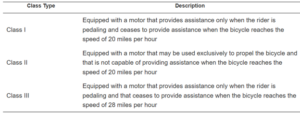
Source: U.S. Department of the Interior
Although e-bikes only recently became popular, the problem that defining them presents is not a novel one. Lansdell said a similar issue existed when roller skates, Heelys, and skateboards first arrived on the scene, with increasing injuries and complaints about where they were used.
“Battery technology, motor development has had progressive growth over the past decade, and the opportunity for the manufacturing of these types of products that were not capable of being manufactured has come into fruition now” Lansdell said. “This new sector of transportation is disrupting the entire transportation system on the road, on the sidewalk and mixed-use paths, greenways, and trails.”
The injuries riders suffer after being hit on any bike can be life-altering, Groninger said. While her practice has seen some crashes involving e-bikes or e-scooters, the type of bike often doesn’t make a difference.
“Even if the person was on an e-bike, it’s not the e-bike that is the cause of the crash, or the cause of the crash isn’t related at all to there being an e-bike involved,” she said.
However, some of these crashes are related to the maintenance of shared rentable e-bikes owned by corporations commonly seen in larger cities, Groninger said.
She said that the classification of e-bikes is a major problem for cyclists, noting that many vehicles misidentified as e-bikes are the source of frustration in the community.
“A lot of complaints to police departments and city councils and a lot of local regulations that are being made really don’t address the issue because they’re kind of throwing the baby out with the bathwater,” Groninger added.
The legislature is currently hashing out how best to regulate e-bikes, and North Carolina is one of a handful of states that doesn’t use the federal government’s three-tier classification system, she said. But as these regulations are developed, there is no clear way to handle manufacturers that are marketing devices as e-bikes that are not e-bikes.
Wilson Jackson, an attorney with Steinberg Law Firm in Charleston, said these higher-powered motorized bikes are not meant to be ridden in bike lanes intended to keep bicyclists safe from traffic, but because of the misclassification, they often are. And it’s problematic.

“In 2022 there were about 27,000 e-bike injuries and the statistics show that as of 2024 there were almost 60,000 e-bike injuries,” Jackson said.
Municipalities are scrambling to regulate these bikes, but the lack of classification makes it difficult. Jackson added that South Carolina also has not adopted the three-tier system.
The insurance gap
Finding insurance coverage that includes accidents involving e-bikes is difficult, and many homeowners’ insurance policies exclude them, Jackson said, requiring a separate insurance policy. Jackson added that lawyers may need to explore product liability claims to see a recovery for their clients, and that South Carolina — which provides for strict liability against the whole distribution chain — has a unique avenue for pursuing these claims.
“Anybody in the supply chain or distribution chain can be sued, and … whatever lawyer is handling your case should be looking at all levels of the distribution chain, because there may be some people in bankruptcy that need to be avoided or handled in a certain way,” he said.
‘Reckless rider’ assumption
In North Carolina, Groninger said there are unique challenges for bike-related injury cases because of the state’s contributory negligence laws. She said that she has seen defense counsel imply that simply by electing to ride a bike on the road, one must be at least partially at fault in a crash.
“Certainly, with scooters there’s sort of a mindset among jurors now, especially because of the lack of regulation and enforcement of what an e-bike actually is … that, ‘Oh, people [who] ride scooters are probably coming home from a bar and they’re reckless,’ or ‘People who ride e-bikes going too fast and they’re reckless,’” she said. “And so, there’s that mindset, and I’m sure that defense attorneys will try to exploit that to use contributory negligence in the defense.”
Bans, crackdowns and parental liability
In South Carolina’s Lowcountry, debate over e-bikes and rentable e-scooters has come to a head, resulting in bans and crackdowns. Jackson said that groups of young teens often gather and ride the motorized devices, adding that it’s only a matter of time before someone is seriously hurt.
“A while back … the city of Charleston implemented an ordinance outlawing [scooters],” Jackson said. “Most recently, in May of this year … that was amended to include all electronic bikes, so I think that the local governments are recognizing that it’s a problem and they’re trying to keep those bikes and scooters out of the way of pedestrians.”
Alex Stalvey, managing partner of Bannister, Wyatt & Stalvey in Greenville, South Carolina, said parents should be wary of the liability they may face if their child causes injury on an e-bike, and the child is too young or the product is misclassified.

“If a parent allowed a minor to operate something that they considered an e-bike but was really a motorcycle for purposes of the law and based on the parent allowing the minor to do that someone else is injured, there could be liability concerns,” Stalvey said.
Related Articles
Related Content





Legal Tech
- How ransomware tactics against law firms are changing
- How large language models are leveling the personal injury playing field
- Attorney Share, Lawmatics integrate to automate law firm referrals
Top Legal News
- US judge approves Anthropic’s $1.5 billion settlement of copyright lawsuit
- The legal confusion surrounding e-bikes
- Two Charlotte women file federal claims against immigration agents after Operation Charlotte’s Web arrests
- Are AI prompts privileged? Time will tell
- Chemours PFAS lawsuit involving 2,658 NC plaintiffs settles before trial
- US appeals court strikes down New Jersey’s assault weapons ban on AR-15s
- Property owners lack standing to challenge HOA special assessment




Commentary
- We tore out our own backup generator
- When is a PIP an adverse employment action?
- Legally Speaking: What spring can teach us about active listening
- A useful patent management government notice
- Opinion: NC judges have enormous power. Be sure to vote in November
- The third option: Why your best employees are quietly losing their edge
- AI divorce is real, but family law can still save itself
- ‘AI won’t take your job’ and other things CEOs say before the layoffs
