


 Free Newsletter


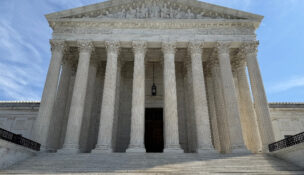
Sara Juhl, left, of Weddington, and Jen Sanders, of Waxhaw, join a rally for educational funding Thursday outside the North Carolina Supreme Court as the tribunal heard arguments in what has become known as the ‘Leandro’ case. (The News & Observer)
‘Leandro’ case again comes before N.C. Supreme Court
The Associated Press//February 23, 2024//


RALEIGH — Longstanding education funding litigation is returning to North Carolina’s highest court hardly a year after a majority of justices — all Democrats — agreed that taxpayer money could be moved to spend on addressing schooling inequities statewide without the express approval of legislators.
What’s apparently changed to permit Thursday’s scheduled oral arguments at the state Supreme Court is its composition. A few days after the court’s milestone 2022 ruling, registered Republicans won back a majority on the seven-member court after success in statewide elections for two seats.
With the partisan shift having taking effect, the five GOP justices agreed in fall 2023 to consider additional arguments sought by Republican legislative leaders opposed to the 2022 decision. Those lawmakers contend only the General Assembly can appropriate state funds.
The justices wrote that Thursday’s matter would be narrowed upon whether Superior Court Judge James Ammons, the latest to oversee the litigation originating almost 30 years ago, had authority last spring to enter an order declaring the state owed $678 million to fulfill two years of an eight-year plan.
But legal briefs filed for Senate leader Phil Berger and House Speaker Tim Moore essentially seek to overturn the November 2022 decision by the then-Democratic controlled court. Action by Ammons’ predcessor, the late Judge David Lee, who approved the initial $5.4 billion plan and ordered some taxpayer funds be moved, served as the focus of the 2022 ruling.
The legislators’ attorneys say there’s never been a legal determination that school districts beyond rural Hoke and Halifax counties had failed to live up to requirements affirmed by the Supreme Court in 1997 and 2004 that the state constitution directs all children must receive the “opportunity to receive a sound basic education.” And, the lawyers argue, school funding decisions are political questions that judicial branch must avoid.
A host of other legal parties, including several school districts, say Ammons’ statewide order must be upheld and implemented. They say it’s the judiciary’s job to fix statewide constitutional deficiencies in pre-kindergarten through 12th grade instruction that the executive and legislative branches failed to address.
Democratic Gov. Roy Cooper is not a legal party in the case but supports carrying out the plan that his administration helped create.
The attorneys supporting the plan — which in part includes funding to improve teacher recruitment and salaries, expand pre-kindergarten and help students with disabilities — argue that Moore and Berger are trying to relitigate the 2022 decision, but it’s well past time procedurally to rehear the matter.
The court’s next opinion date is March 22.
The new Republican majority has ruled favorably for GOP legislators by striking down previous redistricting decisions and upholding a photo voter identification mandate.
Education and civil rights advocates held a rally outside the Supreme Court building while the case was heard.
The litigation began in 1994, when several school districts and families of children sued and accused the state of state law and constitutional violations. The matter often has been referred to as “Leandro” — for the last name of one of the students who sued.
Related Content

Top Legal News
- TikTok to settle with teen plaintiff before California social media trial, law firm says
- County lacked authority to recover homeowners’ damages in code dispute
- Trade secret and confidentiality claims survive against former executive
- Runaway trailer kills driver in head-on crash
- AG Jackson sues federal agencies over Medicaid rule threatening coverage for cancer patients
- Supreme Court strengthens Trump’s hold on key levers of government power
- US Supreme Court takes up Pepsi ‘Mtn Dew Rise’ trademark dispute
- SCOTUS News: 4th Amendment extended to cellphone location data
- Jury consulting booms in the Carolinas
- SCOTUS News: Court rules customs agents can turn back asylum seekers
- Limited hearing ordered on counsel’s failure to use evaluation report



Commentary
- When is a PIP an adverse employment action?
- Legally Speaking: What spring can teach us about active listening
- A useful patent management government notice
- Opinion: NC judges have enormous power. Be sure to vote in November
- The third option: Why your best employees are quietly losing their edge
- AI divorce is real, but family law can still save itself
- ‘AI won’t take your job’ and other things CEOs say before the layoffs
- When not to believe (your lyin’ eyes)
- Conduct a technology audit to improve law firm efficiency
- When the client brings ChatGPT to the consultation
- Content Marketing: Where law firms lose referrals and how to prevent it
- Your best people are not leaving for more money — they are leaving because you stopped paying attention
