


 Free Newsletter

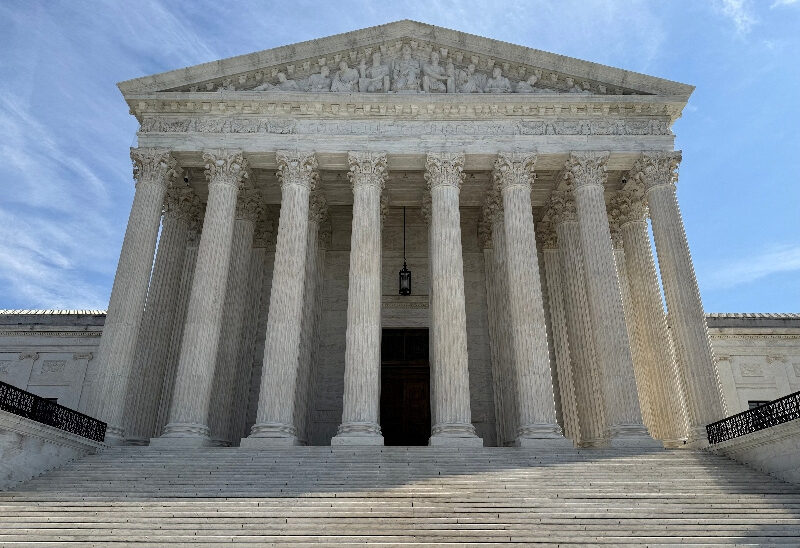
SCOTUS News: 4th Amendment extended to cellphone location data
Pat Murphy//June 30, 2026//


AT A GLANCE
· The U.S. Supreme Court ruled 6-3 that police conduct a Fourth Amendment search when obtaining cellphone location data from Google’s geofence database.
· The case arose from a 2019 Virginia credit union robbery investigation that used a geofence warrant to identify suspects.
· The Court held individuals have a reasonable expectation of privacy in Google Location History data.
· The case was remanded to the 4th Circuit to determine whether the warrant met Fourth Amendment requirements for probable cause and particularity.
Police conducted a Fourth Amendment search requiring a valid warrant when they acquired a robbery suspect’s cellphone location data from Google, the U.S. Supreme Court has ruled in a 6-3 decision.
The case involved the May 2019 robbery of a credit union in Midlothian, Virginia. Police investigating the robbery applied to a state magistrate for a warrant requiring Google to hand over data about the cell phones located within a 150-meter “geofence” of the credit union near the time of the crime.
The magistrate issued the warrant and Google, through a multi-step search process outlined by law enforcement in the warrant application, produced three cellphone users’ identifying information, including that of petitioner Okello Chatrie.
Chatrie’s location data showed that he entered the geofence about ten minutes before the robbery and headed toward a residential area immediately after leaving. Those movements matched the movements of the robber as described by eyewitnesses.
A federal grand jury subsequently indicted Chatrie for robbery and related firearms offenses. In moving to suppress evidence of his cellphone location data, the petitioner argued that law enforcement had obtained the data through a search subject to the Fourth Amendment. Further, the petitioner argued that the warrant issued in his case was invalid.
A federal judge concluded that the geofence warrant “plainly violates the rights enshrined in [the Fourth] Amendment,” but denied the motion to suppress based on the good-faith exception to the exclusionary rule.
A divided panel of the 4th U.S. Circuit Court of Appeals affirmed on a different ground, holding that no search occurred because Chatrie did not have a reasonable expectation of privacy in the two hours’ worth of location history data he voluntarily exposed to Google. The 4th Circuit granted a rehearing en banc. In a one-sentence per curiam decision affirming the denial of Chatrie’s motion to suppress, the court divided evenly on whether a Fourth Amendment search had occurred.
The Supreme Court granted certiorari on the question of whether the police violated the Fourth Amendment in obtaining Chatrie’s location data.
Recognizing that an individual has a reasonable expectation of privacy in his cell-phone location information, the court held that officers conducted a Fourth Amendment search when they acquired Chatrie’s location data from Google.
The court remanded the matter to the 4th Circuit to decide whether each step of the multi-step search process outlined by law enforcement in the warrant application satisfied the Fourth Amendment’s requirements of particularity and probable cause.
Click here to read the full text of the Supreme Court’s June 29 decision in Chatrie v. United States.
To the point
“In his famed and vindicated dissent, Justice [Louis D.] Brandeis explained why a wiretap was a search, subject to Fourth Amendment requirements. See Olmstead v. United States, 277 U. S. 438, 471 (1928). Those who drafted the Amendment could not have imagined such a technology. But they understood, Justice Brandeis wrote, a matter of more transcendent importance: that Americans had ‘as against the Government, the right to be let alone’ and that the Fourth Amendment must protect against ‘every unjustifiable intrusion by the Government upon the privacy of the individual, whatever the means employed.’ Far more recently, this Court in Carpenter [v. United States, 585 U. S. 296], invoked Justice Brandeis’s opinion in explaining why law enforcement officials could not have ‘unrestricted access to a wireless carrier’s database of physical location information.’ Said Carpenter: ‘[T]he Court is obligated — as “[s]ubtler and more far-reaching means of invading privacy have become available to the Government”—to ensure that the “progress of science” does not erode Fourth Amendment protections.’ For new technological tools, the Court continued, may ‘risk[] Government encroachment of the sort the Framers, after consulting the lessons of history, drafted the Fourth Amendment to prevent.’
“Today’s decision follows from the same judicial obligation, to guard against the same risk of undue encroachment. The Fourth Amendment applies, too, when officials tap into Google’s ‘database of physical location information.’ That database is new, but the principle covering it is not: That principle is instead the one our history has given. The Fourth Amendment must, as ever, protect against unjustified governmental intrusion on the privacy of the individual.”
— Justice Elena Kagan, joined by Chief Justice John G. Roberts Jr. and Justices Sonjia Sotomayor, Brett M. Kavanaugh and Ketanji Brown Jackson, opinion of the court
“I agree with the Court that law enforcement officers conducted a search when they accessed petitioner Chatrie’s Location History. I write separately because I would have gone further to explain that this search violated the Fourth Amendment. As the Court observes, ‘[w]hen officers have obtained a warrant,’ the validity of a search turns on ‘whether a magistrate has properly found probable cause to support a particularly described search.’ In my view, it is clear that at a minimum the second and third stages of the search process here did not satisfy this foundational requirement.
“At step two, the warrant authorized officers to access an additional hour’s worth of Location History, unbounded by the geofence’s perimeter. Though the warrant stated that officers would ‘attempt to narrow down the list’ of devices subject to this step, there was no explicit requirement that they do so. Nor did the warrant set forth any criteria that officers would use in their narrowing efforts.
“The same infirmities carried over to step three. At this step, the warrant authorized officers to access ‘identifying account information,’ including the username, date of birth, account number, and any email addresses or telephone numbers associated with the account. Once again, the warrant stated only that officers would ‘attempt to narrow down the list,’ without setting forth any criteria for doing so.”
— Justice Ketanji Brown Jackson, joined by Justice Sonjia Sotomayor, concurring
“I might have hoped that the Court would have pursued a more traditional approach to the Fourth Amendment today. But look carefully and you will see hints of it at work even in the Court’s opinion. Why is the Court so protective of Location History data, email, and electronically stored photos and calendars? Because, it turns out, ‘a user reasonably understands’ all those things ‘as his own.’ Put another way, they are his effects. And why does the Court hold Mr. Chatrie’s effects protected by the Fourth Amendment even though a third party stores them? Because, the Court says, those effects remain his ‘even though [they are] stored on Google’s servers.’ Put another way, entrusting your effects to a third party for certain agreed purposes doesn’t mean they are no longer yours. While more work may lie ahead to bring coherence to our Fourth Amendment jurisprudence, perhaps this is a start.”
— Justice Neil M. Gorsuch, concurring in judgment
“Eight years ago, I warned that this Court’s decision in Carpenter v. United States would produce one of two outcomes. Either the Court would need to clarify Carpenter‘s limits in a future decision, or Carpenter would usher in ‘revolutionary developments’ in our doctrine by giving criminal suspects a ‘protected Fourth Amendment interest in any sensitive personal information about them that is collected and owned by third parties.’ Today, the Court takes the country down the latter path. In doing so, the Court sheds Carpenter‘s self-imposed boundaries and further destabilizes longstanding Fourth Amendment jurisprudence.
“To make matters worse, the majority does all this in an advisory opinion. Although today’s decision will send seismic waves through our Fourth Amendment doctrine, not one iota of the majority opinion will affect the outcome of this case. The Court knows this and does not claim otherwise. Indeed, by refusing to review the one question that could have at least theoretically given Chatrie some hope of relief, the Court carefully set the stage for its planned performance: striking a pose as a great champion of privacy in the digital age. I cannot support this irresponsible escapade.”
— Justice Samuel L. Alito Jr., joined in part by Justices Clarence Thomas and Amy Coney Barrett, dissenting
“I have no quarrel with Carpenter v. United States or with the Court’s decision to grant certiorari in this case. But I agree with JUSTICE ALITO that under our Fourth Amendment precedent, including Carpenter, Chatrie had no reasonable expectation of privacy in data about his public movements that he voluntarily disclosed to Google.”
— Justice Amy Coney Barrett, dissenting
Related Articles
Related Content

Top Legal News
- AG Jackson sues federal agencies over Medicaid rule threatening coverage for cancer patients
- Supreme Court strengthens Trump’s hold on key levers of government power
- US Supreme Court takes up Pepsi ‘Mtn Dew Rise’ trademark dispute
- SCOTUS News: 4th Amendment extended to cellphone location data
- Jury consulting booms in the Carolinas
- SCOTUS News: Court rules customs agents can turn back asylum seekers
- Limited hearing ordered on counsel’s failure to use evaluation report
- As Supreme Court’s term nears its end, three major Trump rulings due
- SCOTUS News: State concealed-carry restriction violates 2nd Amendment
- File-sharing conviction qualifies as crime of child abuse under immigration law
- World court judges sue Trump administration over sanctions



Commentary
- When is a PIP an adverse employment action?
- Legally Speaking: What spring can teach us about active listening
- A useful patent management government notice
- Opinion: NC judges have enormous power. Be sure to vote in November
- The third option: Why your best employees are quietly losing their edge
- AI divorce is real, but family law can still save itself
- ‘AI won’t take your job’ and other things CEOs say before the layoffs
- When not to believe (your lyin’ eyes)
- Conduct a technology audit to improve law firm efficiency
- When the client brings ChatGPT to the consultation
- Content Marketing: Where law firms lose referrals and how to prevent it
- Your best people are not leaving for more money — they are leaving because you stopped paying attention
