


 Free Newsletter

AG Jackson sues to protect federal loan access for healthcare students
North Carolina Lawyers Weekly Staff//May 20, 2026//
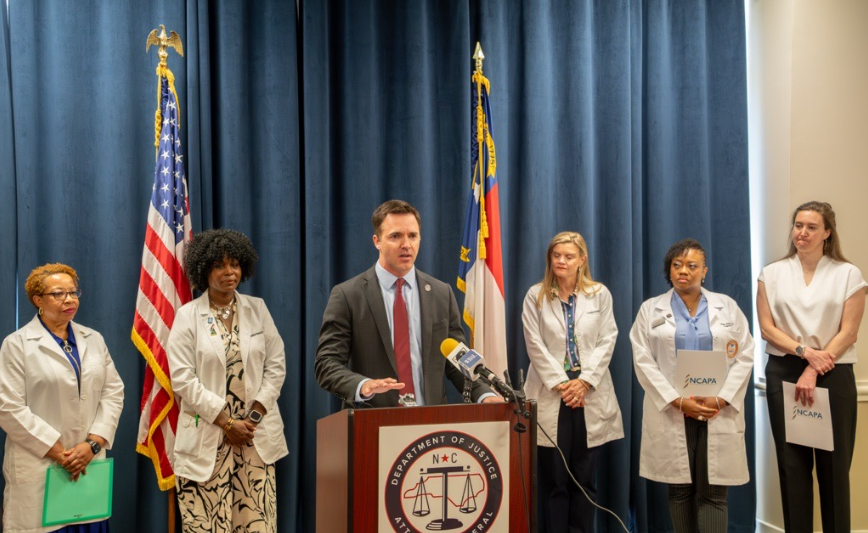
Photo courtesy of the North Carolina Attorney General's Office.
AG Jackson sues to protect federal loan access for healthcare students
North Carolina Lawyers Weekly Staff//May 20, 2026//


Summary:
- Attorney General Jeff Jackson files suit against U.S. Department of Education
- New rule limits federal loans to $20,500 for nursing and healthcare students
- 23 states and DC attorneys general join lawsuit with governors of Kentucky and Pennsylvania
North Carolina Attorney General Jeff Jackson filed suit May 19 against the U.S. Department of Education over a new rule that would limit federal loan access for nursing students, physician assistants, physical therapists, occupational therapists and audiologists, according to a press release from the Attorney General’s Office.
The rule, which takes effect July 1, narrows the definition of “professional” degree beyond the definition Congress established, effectively excluding those healthcare workers from borrowing what they need to complete their graduate programs, the release said. Students pursuing those programs would be limited to $20,500 per year in federal loans, a cap that falls short of the actual cost of many programs. Graduate nursing programs, for instance, routinely cost more than $30,000 per year before living expenses.
“This isn’t just about a worker shortage — it’s a respect shortage,” Jackson said. “Singling out nursing students and physician assistants for less financial aid is telling them the work they do isn’t important. That’s untrue and unfair. They are professionals under the law, and we’re going to court to make sure the Department of Education treats them that way.”
The lawsuit argues the Department of Education is illegally rewriting a definition that Congress established when it passed legislation in 2025 capping graduate student loan borrowing. What Congress did not do, the release said, was change the pre-existing definition of professional degrees. The rule would affect even certified registered nurse anesthetists — who must hold a four-year college degree and complete a three-year doctoral program — and who deliver anesthesia in 80 percent of rural communities.
The stakes are particularly high for North Carolina, where 93 of 100 counties already have a primary care shortage and more than 2.3 million residents live in areas with a shortage of primary healthcare professionals, according to the release. The state ranks among the worst in the nation for healthcare access and affordability.
“Nurses who hold professional graduate degrees are educated with the highest level of rigor, science, and clinical expertise — skills that are deeply needed in every corner of the country, particularly in my home state of North Carolina and other states with large rural populations,” said American Academy of Nursing President Debra J. Barksdale. “This rule will have far-reaching consequences for both patient care and the nursing workforce. It threatens access to care, particularly in areas that are underserved, and creates additional financial barriers for nurses seeking advanced education.”
North Carolina Academy of Physician Associates President-Elect Chileatha Wynn noted the state’s historic role in the profession. “North Carolina is the birthplace of the PA profession — one of the fastest growing healthcare professions in the country,” Wynn said. “Since 1967, when the first three PAs graduated from Duke University, the profession has grown to more than 200,000 PAs nationwide. Protecting the pipeline of this group of highly trained clinicians is critical to meeting the needs of patients — especially in states like North Carolina where the vast majority of individuals live in a healthcare provider shortage area.”
State Sen. Gale Adcock, a family nurse practitioner of 39 years who practiced in primary care for 29 years, said the consequences would be long-lasting. “Primary care providers like NPs, PAs, and family physicians, particularly in rural communities, are essential to the health of North Carolinians of all ages,” Adcock said. “The DoE rule removing post-graduate nursing programs from the professional degree category will worsen an already critical situation. The effects of the rule change will be long term and devastating, hamstringing our workforce recruitment and development efforts.”
Dr. Tyler Shultz, president of the American Physical Therapy Association North Carolina, said the rule creates unnecessary barriers. “Restricting federal student loan access for future physical therapists creates unnecessary barriers for students entering a profession already facing growing workforce demands,” Shultz said. “These changes could reduce the number of qualified physical therapists entering the workforce and ultimately limit access to healthcare for patients and communities across our state.”
Bonnie Davis Meadows, president of the North Carolina Nurses Association, said the rule would compound existing workforce challenges. “With provider shortages at every level, we should be maximizing the capabilities of our entire profession,” Meadows said. “Simply put: making it harder to become a nursing professor or an Advanced Practice Registered Nurse will make it harder for the entire healthcare system to fill gaps in care.”
Projections estimate a national shortage of 20,200 to 40,400 primary care physicians by 2036, according to the release. Attorney General Jackson is joined in the lawsuit by the attorneys general of 23 states and the District of Columbia, as well as the governors of Kentucky and Pennsylvania.
Related Articles
Related Content


Top Legal News
- AG Jackson sues federal agencies over Medicaid rule threatening coverage for cancer patients
- Supreme Court strengthens Trump’s hold on key levers of government power
- US Supreme Court takes up Pepsi ‘Mtn Dew Rise’ trademark dispute
- SCOTUS News: 4th Amendment extended to cellphone location data
- Jury consulting booms in the Carolinas
- SCOTUS News: Court rules customs agents can turn back asylum seekers
- Limited hearing ordered on counsel’s failure to use evaluation report
- As Supreme Court’s term nears its end, three major Trump rulings due
- SCOTUS News: State concealed-carry restriction violates 2nd Amendment
- File-sharing conviction qualifies as crime of child abuse under immigration law
- World court judges sue Trump administration over sanctions



Commentary
- When is a PIP an adverse employment action?
- Legally Speaking: What spring can teach us about active listening
- A useful patent management government notice
- Opinion: NC judges have enormous power. Be sure to vote in November
- The third option: Why your best employees are quietly losing their edge
- AI divorce is real, but family law can still save itself
- ‘AI won’t take your job’ and other things CEOs say before the layoffs
- When not to believe (your lyin’ eyes)
- Conduct a technology audit to improve law firm efficiency
- When the client brings ChatGPT to the consultation
- Content Marketing: Where law firms lose referrals and how to prevent it
- Your best people are not leaving for more money — they are leaving because you stopped paying attention
