


 Free Newsletter

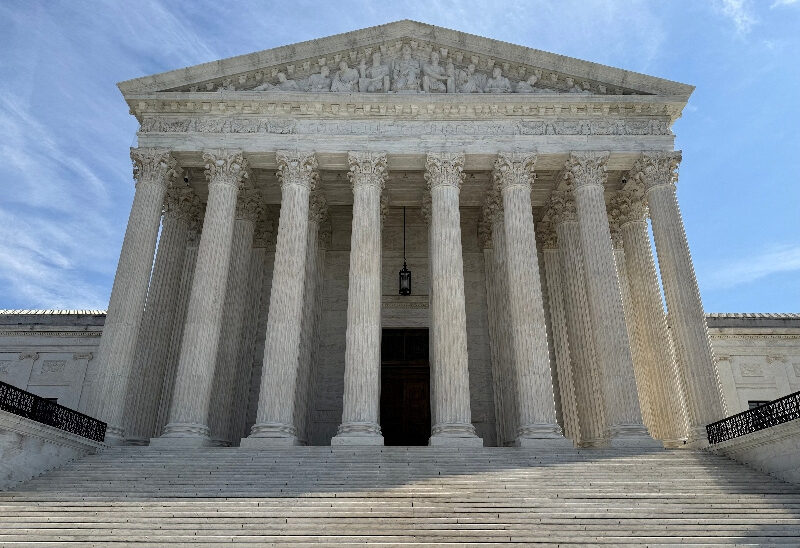
Ruling clarifies calculation of ERISA withdrawal liability
Pat Murphy//May 25, 2026//


AT A GLANCE
· Supreme Court unanimously ruled ERISA permits post-measurement actuarial assumptions in withdrawal liability calculations.
· The dispute centered on whether pension plans could use discount rates adopted after the statutory measurement date.
· The ruling resolved a circuit split between the D.C. Circuit and the 2nd Circuit.
· Justice Ketanji Brown Jackson wrote that ERISA’s statutory text does not restrict assumptions to those adopted before the measurement date.
The Employee Retirement Income Security Act allows the use of actuarial assumptions adopted after the statutory “measurement date” in calculating the withdrawal liability of employers who stop participating in an underfunded multiemployer pension plan, a unanimous U.S. Supreme Court has ruled in resolving a circuit split.
Under ERISA, an employer that ends its participation in an underfunded multiemployer pension plan is required to pay withdrawal liability representing the employer’s share of the plan’s unfunded vested benefits (UVBs). Pursuant to the provisions of 29 U.S.C. §1391, withdrawal liability is calculated based on the plan’s UVBs “as of ” the last day of the so-called “measurement date” or last day of the plan year preceding the employer’s withdrawal.
The value of a plan’s UVBs is determined based on certain data, including the number of beneficiaries and the value of the plan’s assets. Further, the value of a plan’s UVBs may take into account certain actuarial assumptions.
Section 1393 governs the use of actuarial assumptions and states that assumptions must be “reasonable,” “tak[e] into account the experience of the plan and reasonable expectations,” and “offer the actuary’s best estimate of anticipated experience under the plan.”
One key actuarial assumption used in determining the value of a plan’s UVBs is the interest rate “used to discount future benefit payments to their present value.”
The petitioners in the case are four employers who withdrew from the IAM National Pension Fund between April and December 2018. The fund assessed each employer’s withdrawal liability using a measurement date of Dec. 31, 2017. In making its assessment, the fund applied a discount rate of 6.50 percent adopted with its actuarial firm in January 2018. The fund had previously used a discount rate of 7.50 percent to value its UVBs.
The petitioners challenged their assessments in separate arbitration proceedings. In each case, the arbitrators concluded the fund’s assessments were erroneous since they were based on actuarial assumptions adopted after the measurement date. Rather than the 6.50 percent discount rate adopted in January 2018, the arbitrators determined the fund was required to use the 7.50 discount rate actually in effect on the Dec. 31, 2017, measurement date.
The fund sought review of the arbitrators’ decisions in federal court. In each case, federal judges overturned the arbitrator’s award, concluding the fund’s actuaries could use assumptions adopted after the measurement date. The U.S. Court of Appeals for the D.C. Circuit affirmed in a consolidated appeal.
Given that the decision of the D.C. Circuit was in conflict with a decision of the 2nd U.S. Circuit Court of Appeals, the Supreme Court granted certiorari to resolve when actuarial assumptions may be selected for purposes of calculating withdrawal liability.
Affirming the D.C. Circuit’s decision, the Supreme Court held that ERISA’s measurement date provision, §1391, and the laws’ actuarial assumption provision, §1393, when read together do not require that the actuarial assumptions underlying the calculation of the value of UVBs be selected on or before the measurement date.
Click here to read the full text of the Supreme Court’s May 21 decision in M & K Employee Solutions v. Trustees of the IAM National Pension Fund.
To the point
“Plans and their actuaries, petitioners worry, will retroactively select assumptions in order to increase withdrawing employers’ liability. But their proposed rule —that withdrawal liability must be based on assumptions adopted before the measurement date — does nothing to address these concerns. Plans and actuaries could still select assumptions with an eye towards inflating withdrawal liability before the measurement date given the significant discretion they enjoy in selecting assumptions.
“In any event, ‘policy concerns cannot trump the best interpretation of the statutory text.’ Congress chose which limits to impose on the selection of actuarial assumptions. The statute requires that actuarial assumptions be ‘reasonable’ and reflect actuaries’ ‘best estimate.’ §1393(a)(1). And the statute permits employers to challenge actuarial assumptions in arbitration, including on the ground that they were ‘unreasonable.’ §1401(a)(3)(B)(i). Indeed, many of the worst-case scenarios petitioners posit — for example, that actuaries will adopt intentionally low discount rates for withdrawal liability but high discount rates for other purposes — are subject to challenge in arbitration. It is not the role of the Court to supplant Congress’s choices, as reflected in the statutory text, with our own.”
— Justice Ketanji Brown Jackson, opinion of the court
Related Articles
Related Content






Top Legal News
- Ruling clarifies calculation of ERISA withdrawal liability
- Prison contractor bankruptcy halts collection of $307.5M verdict
- Collateral estoppel bars renewed negligent credentialing claims
- Elon Musk’s X loses Australia child protection compliance lawsuit
- Why North Carolina Lawyers Weekly is proud to endorse Best Places to Work in Law Firms
- Attorneys navigate increase in challenging UTV & ATV crashes
- Non-citizens face more scrutiny on bank activities after Trump order
- AG Jackson sues to protect federal loan access for healthcare students
- Forfeiture mandatory after money laundering convictions
- Prior consensual misconduct by officers not enough to put town on notice of sexual assault risk
- US Supreme Court rebuffs pharma challenge to Biden-era drug price



Commentary
- ‘AI won’t take your job’ and other things CEOs say before the layoffs
- When not to believe (your lyin’ eyes)
- Conduct a technology audit to improve law firm efficiency
- When the client brings ChatGPT to the consultation
- Content Marketing: Where law firms lose referrals and how to prevent it
- Your best people are not leaving for more money — they are leaving because you stopped paying attention
- Best at Work Insights: The choice we’re making about AI
- New life for the noncompete
- 2026: The year of tech, both heroes and villains
- Beyond burnout: The case for workplaces where people thrive
- The December question every leader should anticipate
- How do parent corporations deal with Workers’ Compensation?
