


 Free Newsletter

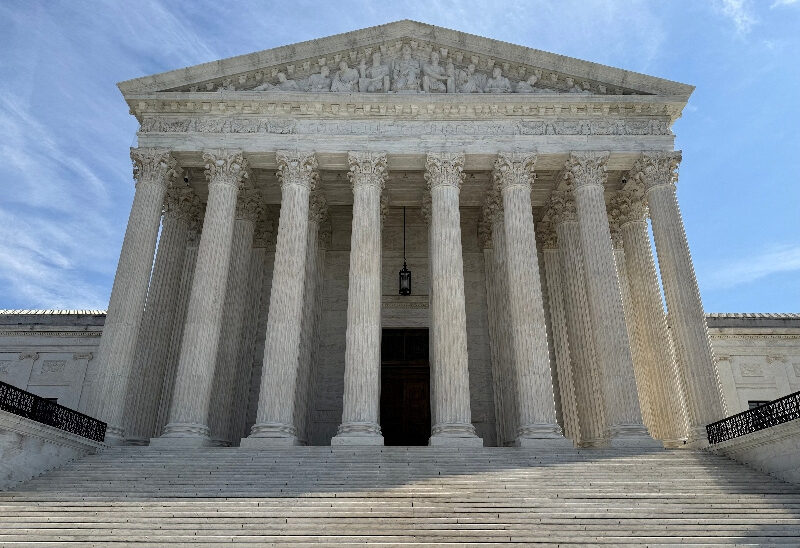
SCOTUS: Injured trucker’s negligent-hiring claim not preempted
Pat Murphy//May 15, 2026//


AT A GLANCE
· U.S. Supreme Court unanimously ruled the Federal Aviation Administration Authorization Act does not preempt negligent-hiring claims against freight brokers.
· Truck driver Shawn Montgomery suffered severe injuries after a parked tractor-trailer was struck in Illinois.
· The case centered on whether the FAAAA’s safety exception preserves state tort claims involving motor vehicle safety.
· Justice Amy Coney Barrett wrote that state safety regulations are a limited exception to federal preemption under trucking law.
Federal transportation law does not preempt a negligent-hiring claim brought by a truck driver who sustained severe and permanent injuries when his parked tractor-trailer was struck by a truck transporting a shipment under a contract arranged by a third-party broker, a unanimous U.S. Supreme Court has ruled.
The Federal Aviation Administration Authorization Act preempts state laws related to the prices, routes and services of the trucking industry. The FAAAA includes an exception under 49 U.S.C. §14501(c)(2)(A), which provides the act’s preemption provision “shall not restrict the safety regulatory authority of a State with respect to motor vehicles.”
The plaintiff in the case, Shawn Montgomery, sustained severe and permanent injuries when his tractor trailer, which he had parked on the side of the road, was struck by a truck driven by Yosniel Varela-Mojena. At the time, Varela-Mojena was driving a load of plastic pots through Illinois for motor carrier Caribe Transport II, LLC. Transportation broker C.H. Robinson Worldwide, Inc. had coordinated the shipment of plastic pots.
Montgomery brought personal injury claims in federal court against Varela-Mojena, Caribe Transport and C.H. Robinson. In suing C.H. Robinson, the plaintiff alleged the broker was negligent in hiring Varela-Mojena and Caribe Transport because the broker knew or should have known from Caribe Transport’s safety rating that hiring it to transport goods was reasonably likely to result in crashes that would injure others.
A federal judge in Illinois granted C.H. Robinson’s motion for summary judgment, concluding the FAAAA expressly preempted Montgomery’s negligent-hiring
claim. In addition, the judge ruled that his claim did not fall within the FAAAA’s safety exception.
After a panel of the 7th U.S. Circuit Court of Appeals affirmed, the Supreme Court granted Montogomery’s petition for certiorari to resolve a circuit split as to whether the FAAAA’s safety exception permits negligent-hiring claims against brokers that coordinate shipments in the transportation industry.
The Supreme Court held that a claim that a company negligently hired another to transport goods is not preempted by the FAAAA, given that states retain the authority under the act to regulate safety “with respect to motor vehicles.”
Click here to read the full text of the Supreme Court’s May 14 decision in Montgomery v. Caribe Transport II, LLC.
TO THE POINT: “C.H. Robinson and the United States contend that construing the safety exception as Montgomery requests would swallow the FAAAA’s express preemption provision whole. In other words, everything that Congress preempted would also qualify for the safety exception. Not so. Recall that the express preemption provision applies to laws and regulations ‘related to a price, route, or service of’ motor carriers or brokers ‘with respect to the transportation of property.’ The safety exception saves only a subset of preempted claims: those involving regulations concerning motor vehicle safety. One can imagine many state laws that are related to motor carrier prices, routes, and services — such as how much a carrier may charge or which highways it may traverse —that have no relationship to safety.”
— Justice Amy Coney Barrett, opinion of the court
“As I see it, the conflicting contextual considerations make this a close case as we determine how to construe and where to draw the line on the statutory phrase ‘with respect to motor vehicles.’ In the end, I do not believe that Congress, through such oblique language in an economic-deregulation statute, simultaneously (i) allowed state tort suits against negligent trucking companies and (ii) categorically preempted state tort suits against upstream brokers who negligently select an unsafe trucking company. The brokers and their amici raise serious concerns about the repercussions of state tort liability against brokers, and they may of course (among other possibilities) ask Congress and the President to change federal law. But as of now, federal law does not preempt state tort liability against brokers for negligent selection of trucking companies.”
— Justice Brett M. Kavanaugh, joined by Justice Samuel A. Alito Jr., concurring
Related Articles
Related Content






Top Legal News
- Company accused of using per diem structure to avoid overtime obligations
- DEA, police raided Bucks home at gunpoint. Wrong address, lawsuit says
- Franchisee contract claims proceed over alleged misuse of marketing fees
- SCOTUS: Injured trucker’s negligent-hiring claim not preempted
- US appeals court questions Trump’s push to punish major law firms
- South Carolina lawyer Murdaugh’s murder conviction overturned
- Wage claims survive dismissal in employment dispute
- SC GOP announces plans to file a federal lawsuit to close primaries
- Evidence of undue influence required jury review in will dispute
- Asheville faces lawsuit after fatal sanitation truck accident
- Surgical misidentification leaves 2-year-old injured



Commentary
- When not to believe (your lyin’ eyes)
- Conduct a technology audit to improve law firm efficiency
- When the client brings ChatGPT to the consultation
- Content Marketing: Where law firms lose referrals and how to prevent it
- Your best people are not leaving for more money — they are leaving because you stopped paying attention
- Best at Work Insights: The choice we’re making about AI
- New life for the noncompete
- 2026: The year of tech, both heroes and villains
- Beyond burnout: The case for workplaces where people thrive
- The December question every leader should anticipate
- How do parent corporations deal with Workers’ Compensation?
- Best at Work Insights: Don’t Import 996: Why America Should Reject Overwork Culture
