


 Free Newsletter

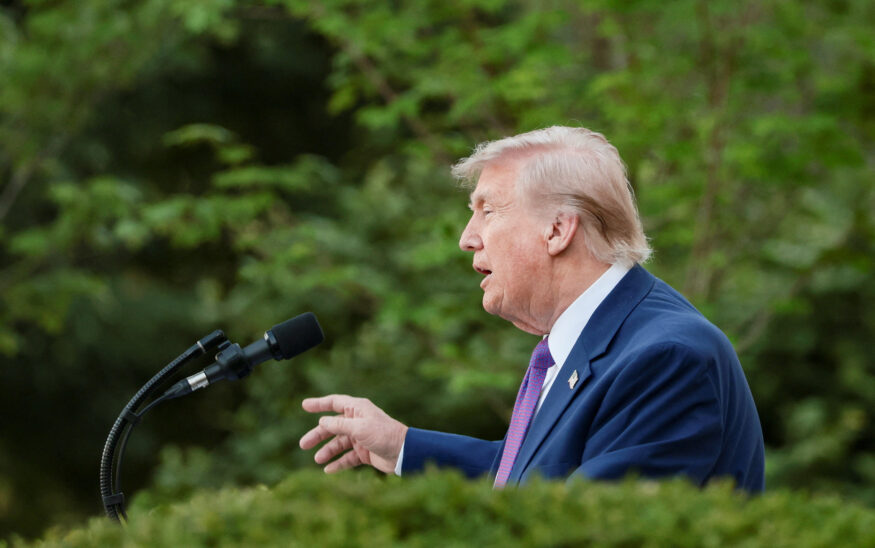
U.S. President Donald Trump delivers remarks as he hosts his second 'Rose Garden Club' dinner in honour of Police Week at the White House in Washington, D.C., U.S., May 11, 2026. REUTERS/Evelyn Hockstein
US appeals court questions Trump’s push to punish major law firms
Reuters//May 14, 2026//


Summary:
- Trump executive orders barred four major law firms from federal contracts
- D.C. Circuit panel questioned presidential authority over security clearances
- Law firms Perkins Coie, Jenner & Block, WilmerHale, Susman Godfrey involved
President Donald Trump‘s administration faced a skeptical federal appeals court panel on May 14 in its bid to revive the Republican leader’s executive orders punishing four major U.S. law firms, testing the scope of presidential power after judges in Washington resoundingly rejected the measures as unlawful.
A law firm’s commercial associations, including the lawyers it hires, are not protected by the U.S. Constitution’s First Amendment, Justice Department lawyer Abhishek Kambli told a panel of the U.S. Court of Appeals for the District of Columbia Circuit.
Former Republican-appointed U.S. Solicitor General Paul Clement, who is arguing for the law firms, countered that Trump’s executive orders “strike at the heart of the First Amendment and the ability of lawyers to zealously represent their clients.”
COURT FOUND ORDERS VIOLATED FREE SPEECH
The targeted law firms — Perkins Coie, Jenner & Block, WilmerHale and Susman Godfrey — each won sweeping victories in the lower federal court, where four Democratic- and Republican-appointed judges last year separately found Trump’s executive orders violated free speech and other provisions of the U.S. Constitution.
Trump’s orders cited the law firms’ legal work, hiring, diversity policies and political ties. The orders were part of a broader campaign led by the president since the start of his second term, targeting his perceived enemies.
The executive orders sought to bar the four firms’ lawyers from accessing federal buildings and to terminate U.S. government contracts held by their clients. The orders also stripped employees of the firms of their government security clearances.
The panel hearing Thursday’s arguments included two Democratic-appointed judges and one Republican-appointed judge, each of whom questioned Kambli on the breadth of authority asserted by the administration.
Judge Sri Srinivasan, an appointee of former Democratic President Barack Obama, pressed the Justice Department’s attorney on whether Trump can revoke security clearances for reasons unrelated to their trustworthiness or ability to keep secrets. Kambli said the courts have no authority to review such decisions if the president invokes national security.
“Even if it is for improper motives, it is ultimately unreviewable,” Kambli said.
Clement argued that prior rulings did not fully insulate the president from challenges to security clearance decisions.
“You’re opening the door for a president to say that, ‘I just don’t think Democrats are trustworthy’ or ‘law firms that represent Democrats are trustworthy,’ and I don’t think you want to open that door,” Clement said.
TEST OF CONSTITUTIONAL POWER
In a court filing, the Justice Department told the D.C. Circuit that the cases are “not about the sanctity of the American law firm” but rather “about lower courts encroaching on the constitutional power of the president” in the realm of national security and other matters.
The targeted firms received backing from a host of legal organizations, including the American Bar Association, in urging the D.C. Circuit to reject the administration’s appeals.
“They were singled out because they represented clients or associated with attorneys who raised the president’s ire,” Clement told the appeals court. “While most cases alleging retaliation depend on either speculation or extensive discovery, here the executive orders lay the president’s motives bare.”
Nine other firms, including Paul Weiss and Skadden Arps, settled with the Trump administration to avoid similar orders against them.
The appeals court panel also heard the Trump administration’s appeal of a ruling that barred it from stripping prominent Washington lawyer Mark Zaid of his government security clearance.
The D.C. Circuit’s eventual rulings in both cases can be appealed to the U.S. Supreme Court.
(Reporting by Mike Scarcella; Editing by David Bario, David Gregorio, Rod Nickel)
Related Articles
Related Content



Top Legal News
- US appeals court questions Trump’s push to punish major law firms
- South Carolina lawyer Murdaugh’s murder conviction overturned
- Wage claims survive dismissal in employment dispute
- SC GOP announces plans to file a federal lawsuit to close primaries
- Evidence of undue influence required jury review in will dispute
- Asheville faces lawsuit after fatal sanitation truck accident
- Surgical misidentification leaves 2-year-old injured
- Lawsuit seeks to halt Trump’s makeover of Lincoln Memorial reflecting pool
- ‘Reckless’ response: Officer’s run to routine shoplifting call leaves man paralyzed
- Political commentary not directed at candidate cannot support no-contact order
- NC DOT liable after pedestrian struck in Chapel Hill crosswalk



Commentary
- When not to believe (your lyin’ eyes)
- Conduct a technology audit to improve law firm efficiency
- When the client brings ChatGPT to the consultation
- Content Marketing: Where law firms lose referrals and how to prevent it
- Your best people are not leaving for more money — they are leaving because you stopped paying attention
- Best at Work Insights: The choice we’re making about AI
- New life for the noncompete
- 2026: The year of tech, both heroes and villains
- Beyond burnout: The case for workplaces where people thrive
- The December question every leader should anticipate
- How do parent corporations deal with Workers’ Compensation?
- Best at Work Insights: Don’t Import 996: Why America Should Reject Overwork Culture
